The manufacturing of per- and polyfluoroalkyl substances (PFAS) is a global enterprise historically dominated by a “dirty dozen” of major chemical corporations.
The Dirty Dozen
12 major corporations stand out for their staggering PFAS production. In alphabetical order, they are:
- 3M
- AGC
- Archroma
- Arkema
- BASF
- Bayer
- Chemours
- Daikin
- Dongyue Federation
- Honeywell
- Merck
- Solvay
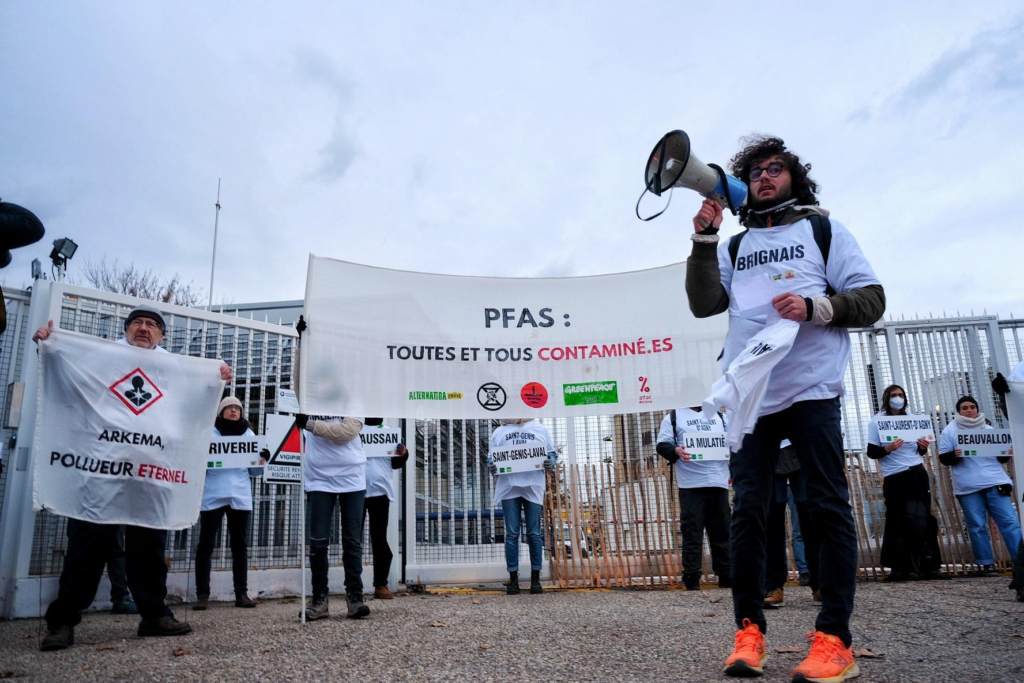
Manufacturing Hubs
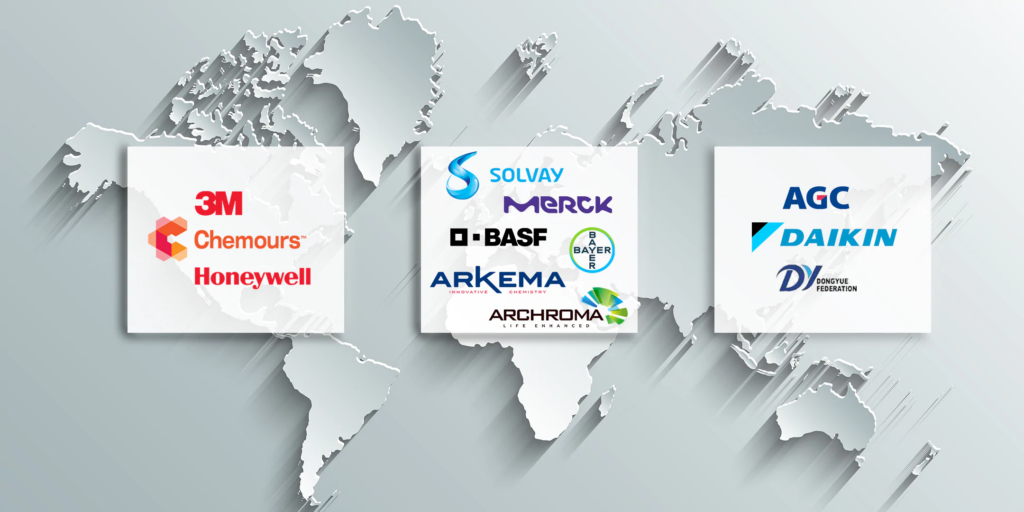
Dirty Dozen map sourced from Chemsec.
Production is heavily concentrated in specific industrial hubs across the United States, Europe, and Asia. The primary corporate actors driving this supply chain include 3M (USA), Chemours (a DuPont spin-off, USA), Daikin (Japan), Solvay (Belgium), Arkema (France), AGC Inc. (Japan), and the Dongyue Group (China).
The geography of PFAS is currently undergoing a radical shift driven by litigation, environmental liability, and “forever chemical” regulations.
The Western Retreat
Major Western manufacturers are exiting the market. 3M has committed to discontinuing all PFAS manufacturing by the end of 2025, and BASF plans to exit by 2028. Additionally, companies like Arkema are phasing out specific surfactants, and DuPont/Chemours have entered into massive settlement agreements to address historic contamination.
“While PFAS can be safely made and used, we also see an opportunity to lead in a rapidly evolving external regulatory and business landscape to make the greatest impact for those we serve. This action is another example of how we are positioning 3M for continued sustainable growth by optimizing our portfolio, innovating for our customers, and delivering long-term value for our shareholders.”
3M chairman and chief executive officer Mike Roman
Even when these companies pledge to phase out PFAS, we must be weary of their words: in Mike Roman’s statement, we see that 3M’s phasing out of PFAS is nothing more than a business move in the interest of shareholders. The company dangerously muddies the water by asserting that PFAS can be “safely made and used” – it is in their best financial and social interest to essentially cover their backs and tracks.
After all, there is a very long history of these major corporations deceiving and poisoning consumers, as demonstrated in this report:
Subsequent Implications
As U.S. and European firms exit or reduce output, global reliance is shifting toward Asian manufacturers, suggesting a geopolitical reorganization of the chemical’s supply chain rather than a total global cessation.
This means that the PFAS market will still be alive and well despite the aforementioned changes; the market has simply shifted geographically. This leads us to the fact that the only way to limit PFAS productions is to advocate for regulatory legislation. Legally banning these toxins are the only way to give us a defense against them. While legislation is still lacking, we can celebrate that, at least in the United States, some individual states have taken it upon themselves to ban production via their own statutory previsions. Connecticut, for instance, will be enforcing manufacturers to include labels on products containing PFAS while Colorado will be banning PFAS entirely.
In tandem with advocating for more policy, we can try to limit our exposure by staying aware: research products and their manufacturers before making purchases to limit your exposure. Stay cognizant of questionable actions from up above. It’s important to stay aware of instances such as the EPA reversing its water protection policies and question the motives of such moves, as well as how these shifts impact public health.
More sources of information
AGC Chemicals Americas. (2024, June 3). Testimony regarding House Bill 2238. Pennsylvania House of Representatives. https://www.palegis.us/house/committees/committee-archives/archive-file?file=2024_0706_0015_tstmny.pdf
Arkema. (2025, May 11). Update on the PFAS situation at the Arkema site in Pierre-Bénite. https://www.arkema.com/france/en/locations/production-centers/pierre-benite/update-pfas-situation-arkema-pierre-benite/
ChemSec. (n.d.). The top 12 PFAS producers in the world and the staggering societal costs of PFAS pollution. International Chemical Secretariat. https://chemsec.org/reports/the-top-12-pfas-producers-in-the-world-and-the-staggering-societal-costs-of-pfas-pollution/
Chemours. (n.d.). Fayetteville Works. https://www.chemours.com/en/about-chemours/global-reach/fayetteville-works
Dongyue Group. (n.d.). About Dongyue Fluorosilicone Science and Technology Group Co., Ltd. https://www.dongyuechem.com/en/about.html
New Jersey Department of Environmental Protection. (2024, March 6). Solvay settlement. State of New Jersey. https://dep.nj.gov/solvay/
