
Basically, PFAS (per- and polyfluoroalkyl substances) are a large class of synthetic chemicals prized for their resistance to heat, water, and oil. They are useful, but to what extent? Even though they are allowing us to live more comfortably now, we are in turn destroying our environment. These harsh chemicals, known sometimes as “forever chemicals” are quite literally stuck with us… forever.
PFAS can initially enter the environment from product manufacturing and use, waste and landfill, and firefighting foams. When released into the air, they can travel long distances by attaching to particles and eventually settling back into the ground or the water. There, PFAS can be ingested and taken in by plants, animals, and through the consumption of plants and animals along with water, humans too. Waste will then reintroduce PFAS back into the environment, and the cycle continues. Additionally, humans can more easily ingest these chemicals when using certain products that contain them, like nonstick cookware.
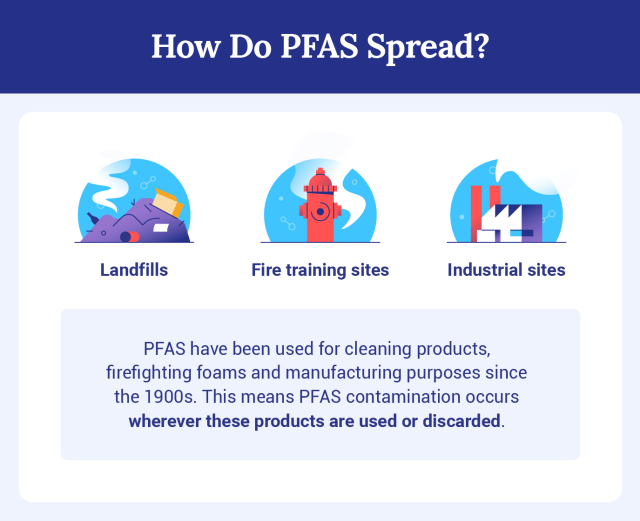
https://www.consumernotice.org/environmental/water-contamination/pfas/products
Dangers of PFAS Spread & Key Pathways of PFAS Spread
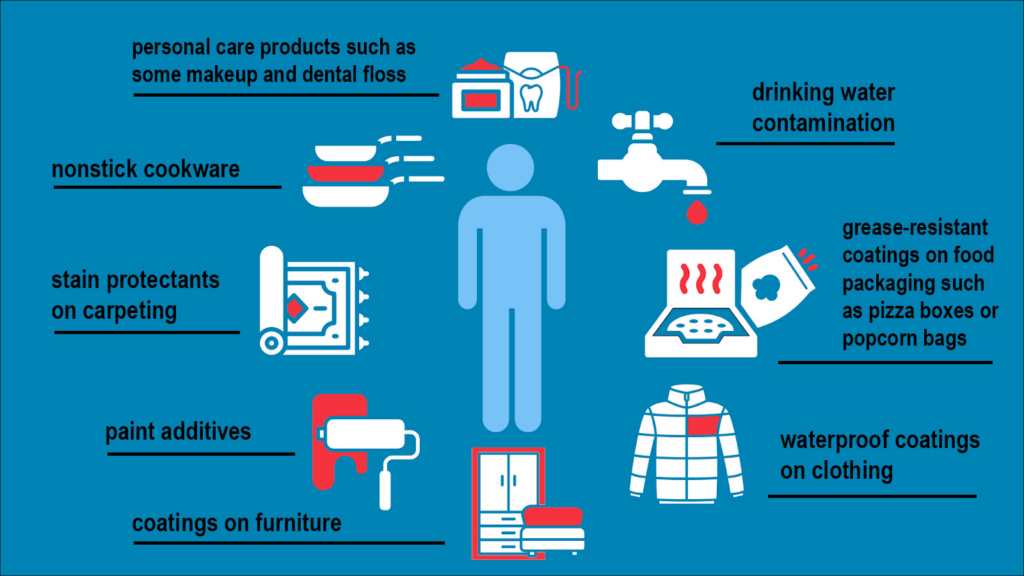
PFAS can enter rivers, lakes, and other bodies of water through runoff from factories, firefighting foam, or landfills and waste-water. Once in water, PFAS can travel long distances and contaminate other water supplies. When this water is used for irrigation or if certain waste products are spread on land, PFAS chemicals can also build up in soil. From there, they can be taken up by crops, which we consume alongside livestock. Our PFAS levels can increase over time as we ingest more and more food with PFAS present. Some PFAS can travel through the air as tiny particles or gases. They may be released during manufacturing or when products are heated. These chemicals can then settle back down into the land or the water. PFAS can be found in everyday products, such as water-resistant clothing, non-stick cookware, and some food packaging. When these items are used or disposed of, we can ingest PFAS or PFAS can be spread back into the environment.
Why PFAS Spread So Easily
PFAS chemicals spread efficiently because they are extremely stable and resistant to natural breakdown processes. Many PFAS compounds dissolve easily in water, allowing them to travel long distances through groundwater systems and surface water. Once present in soil or water, PFAS can accumulate in plants, livestock, wildlife, and humans, a process known as bioaccumulation. As organisms consume contaminated food or water over time, PFAS concentrations can increase within food chains, leading to higher exposure levels in humans.
The PFAS Environmental Cycle
Manufacturing and product use release PFAS into air, soil, and water. From there, rainfall, atmospheric transport, and water runoff move these chemicals into groundwater, rivers, lakes, and agricultural land. Crops and livestock absorb PFAS, which then enter the human food supply through drinking water and consumption of contaminated food. Human waste and landfill disposal can reintroduce PFAS into wastewater systems and the environment, continuing the cycle of contamination.
Because PFAS do not easily degrade and can circulate repeatedly through environmental systems, contamination is rarely limited to a single site. Even a localized release can spread through water systems, agricultural production, and food distribution networks, affecting communities far from the original contamination source. Understanding these environmental pathways is essential for identifying contamination hotspots and supporting monitoring efforts.
Sources
U.S. Environmental Protection Agency. PFAS Explained. https://www.epa.gov/pfas/pfas-explained
U.S. Environmental Protection Agency. Basic Information on PFAS. https://www.epa.gov/pfas
U.S. Food and Drug Administration. PFAS in the Food Supply. https://www.fda.gov/food/environmental-contaminants-food/and-polyfluoroalkyl-substances-pfas
National Institute of Environmental Health Sciences. Perfluoroalkyl and Polyfluoroalkyl Substances. https://www.niehs.nih.gov
Fenton, S. E., Ducatman, A., Boobis, A., DeWitt, J. C., Lau, C., Ng, C., Smith, J. S., and Roberts, S. M. (2020). Per and polyfluoroalkyl substance toxicity and human exposure. Environmental Health Perspectives.
